
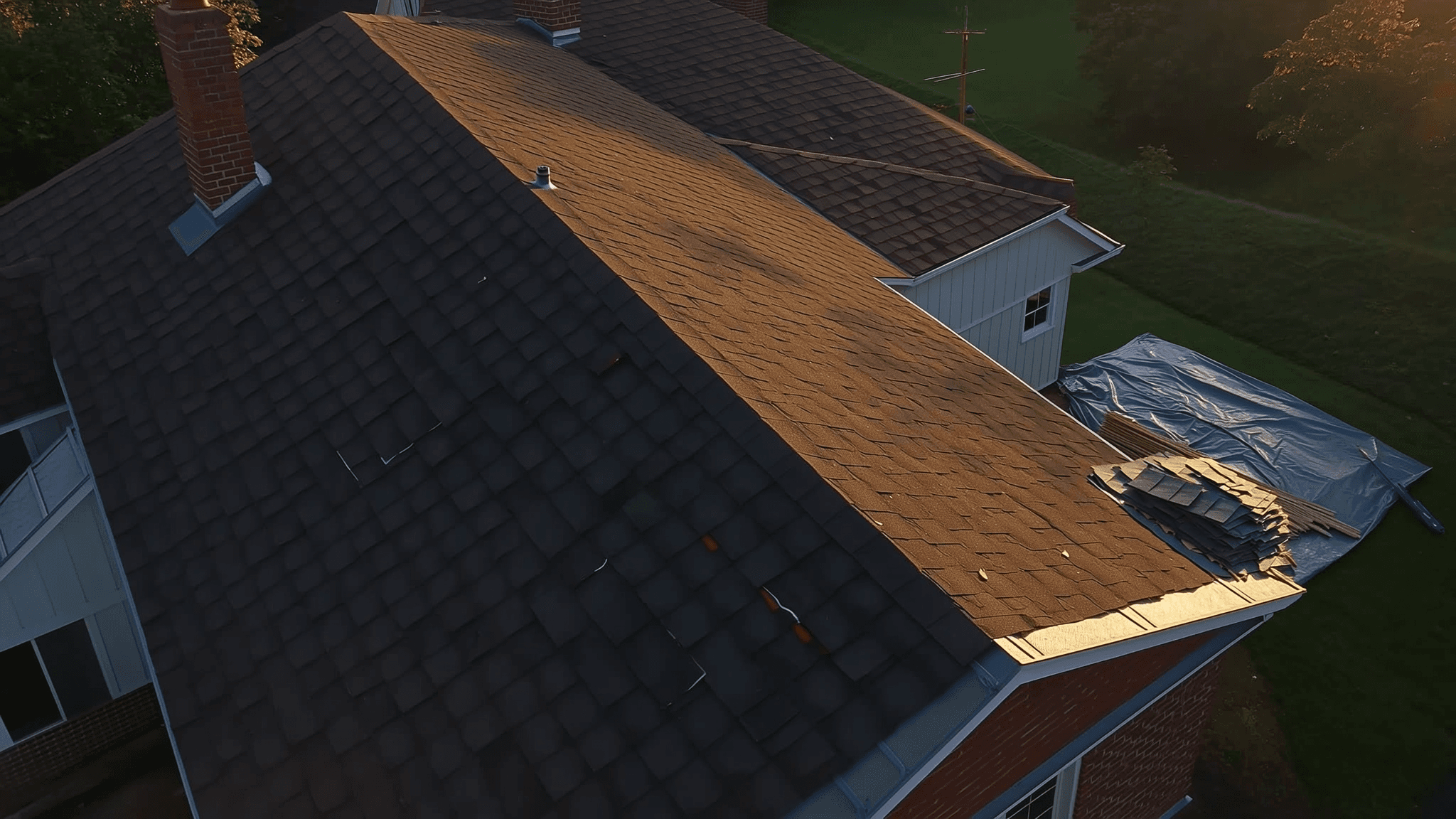
A Midwest summer can be hard on a roof even when there is no hailstorm or obvious leak. Long sunny days, high temperatures, humid air, and rapid shifts between afternoon heat and overnight cooling all put stress on the materials that protect your home.
That does not mean every hot week calls for roofing work. It does mean homeowners should understand what heat and ultraviolet radiation are doing overhead, particularly if the roof is already showing its age. The goal is not to chase cosmetic changes. It is to recognize when normal weathering may be moving toward a replacement decision.
Heat and sunlight age roofing materials over time
Your roof is directly exposed to solar radiation for much of the day. On a sunny afternoon, the roof surface can become substantially hotter than the surrounding air. The U.S. Department of Energy notes that traditional dark-colored roofing materials absorb sunlight and become warm in the sun, while more reflective roof surfaces absorb less solar energy and stay cooler.
Heat matters because elevated temperatures can accelerate chemical reactions and the movement of material components within roofing products. Ultraviolet radiation is another aging force. The Insurance Institute for Business & Home Safety explains that roof coverings face continual UV exposure and that UV wavelengths can degrade the asphalt used in asphalt shingles.
For an asphalt-shingle roof, this is a gradual process rather than a single event. The asphalt layer, protective granules, sealant areas, underlayment, ventilation details, and flashing all work as a system. Sun and heat do not affect every component in exactly the same way, but a roof that has already accumulated years of weather exposure has less margin for future stress.
Daily temperature change adds another layer. Roof materials expand as they heat and contract as they cool. Those movements are expected, but repeated cycling can contribute to wear around joints, penetrations, and areas where materials meet. This is one reason a roof should be evaluated as a complete assembly instead of judging its condition by one shingle seen from the driveway.
What homeowners may notice after a hot summer
Heat and UV exposure do not create one universal visual pattern. Material type, roof orientation, roof color, ventilation, tree cover, installation quality, and the roof’s age all influence what you see. Still, these are reasonable reasons to schedule a professional roof assessment:
- Granules collecting in gutters or at downspouts. Granules are part of an asphalt shingle’s protective surface. Some loss can occur over time, but notable accumulation deserves a closer look.
- Shingles that look curled, distorted, or uneven. A change in the roof plane can indicate that the roofing system needs evaluation.
- Cracking or a brittle-looking surface. UV and heat exposure contribute to the long-term aging of asphalt-based materials.
- Uneven fading. South- and west-facing slopes often receive more direct afternoon sun than other roof areas, so visual weathering may not be uniform.
- Attic discomfort or visible moisture concerns. A hot attic alone does not prove that a roof has failed, but it is a reason to review attic ventilation, insulation, and roofing conditions together.
Do not climb onto a hot roof to investigate. Roofing surfaces can be unsafe underfoot, and heat adds another avoidable risk. Start with a ground-level look after the roof has cooled, check gutters from a safe position, and document anything unusual with photos.
Roof color and reflectance are part of replacement planning
When a full replacement becomes appropriate, color is more than a curb-appeal decision. A roof surface’s solar reflectance describes the share of sunlight it reflects rather than absorbs. The Department of Energy identifies solar reflectance and thermal emittance as key properties affecting roof temperature.
Some asphalt shingles are manufactured and rated with solar-reflectance characteristics. For example, GAF publishes Cool Roof Rating Council solar-reflectance and thermal-emittance values for specific shingle products. That does not make one roof color right for every Midwest home. Winter heating needs, attic insulation, roof design, neighborhood requirements, product availability, and the rest of the roofing system all belong in the conversation.
For homeowners considering future solar, the first question is still roof condition. It is generally more practical to plan solar around a sound, replacement-ready roof than to install equipment over a roof that is approaching the end of its useful service life. Vulcan Construction can discuss roof-first solar readiness during replacement planning, without treating solar as an afterthought.
What to do before fall arrives
Late summer is a useful time to take stock because the roof has been through the hottest part of the year and fall scheduling is approaching. A simple, measured approach works best:
- Look from the ground. Note visible changes in shingle appearance, debris buildup, sagging, or gutter granules.
- Check the attic carefully. Look for daylight, staining, damp insulation, or unusual odors. Avoid treating attic heat by itself as proof of a roofing problem.
- Review the roof’s history. Keep records of installation dates, prior inspections, and any past weather-related concerns.
- Plan early if replacement signs are accumulating. Waiting until water enters the home can reduce your choices and add stress to the project.
Vulcan Construction handles complete roof replacements, not partial repairs. If an assessment points to a localized repair need rather than replacement, we will be direct about that scope and can refer repair work appropriately. If your roof is showing broader age-related wear, review our complete roof replacement process and request a free estimate before fall schedules tighten.
FAQ
Can summer heat damage a newer roof?
Every roof is exposed to heat and UV radiation, but a newer roof is not automatically damaged by a normal summer. Age, product type, installation details, ventilation, roof orientation, and prior weather exposure all affect how a roof performs over time.
Does a darker roof always mean it has a problem?
No. Darker roofing materials generally absorb more sunlight than highly reflective surfaces, but color alone does not determine whether a roof is failing. Condition, installation quality, attic performance, and the entire roofing system matter more than appearance alone.
Should I replace a roof just because shingles are fading?
Not necessarily. Fading can be cosmetic, while other signs may point to more meaningful wear. A professional assessment can help distinguish normal weathering from conditions that support planning a complete replacement.
Is late summer a good time to schedule a roof assessment?
Yes. A late-summer assessment gives homeowners time to understand the roof’s condition and consider replacement options before fall weather and contractor schedules become more constrained.
Sources
- Natural Weathering and Hazard Exposure — Insurance Institute for Business & Home Safety. This source supports the statement that roofs experience continual ultraviolet exposure and that UV wavelengths can degrade the asphalt used in asphalt shingles.
- Weathering of Roofing Materials – An Overview — Lawrence Berkeley National Laboratory. This peer-reviewed overview supports the statement that elevated temperatures accelerate damaging chemical reactions and that ultraviolet radiation, temperature, and moisture contribute to roofing-material weathering.
- Guide to Cool Roofs — U.S. Department of Energy. This guide supports the statements that dark roofing materials absorb sunlight and become warm in the sun, while solar reflectance and thermal emittance influence roof-surface temperature.
- Solar Reflective Products and Ratings for Shingles — GAF. This manufacturer technical document supports the statement that specific asphalt shingle products can have published Cool Roof Rating Council solar-reflectance and thermal-emittance ratings.